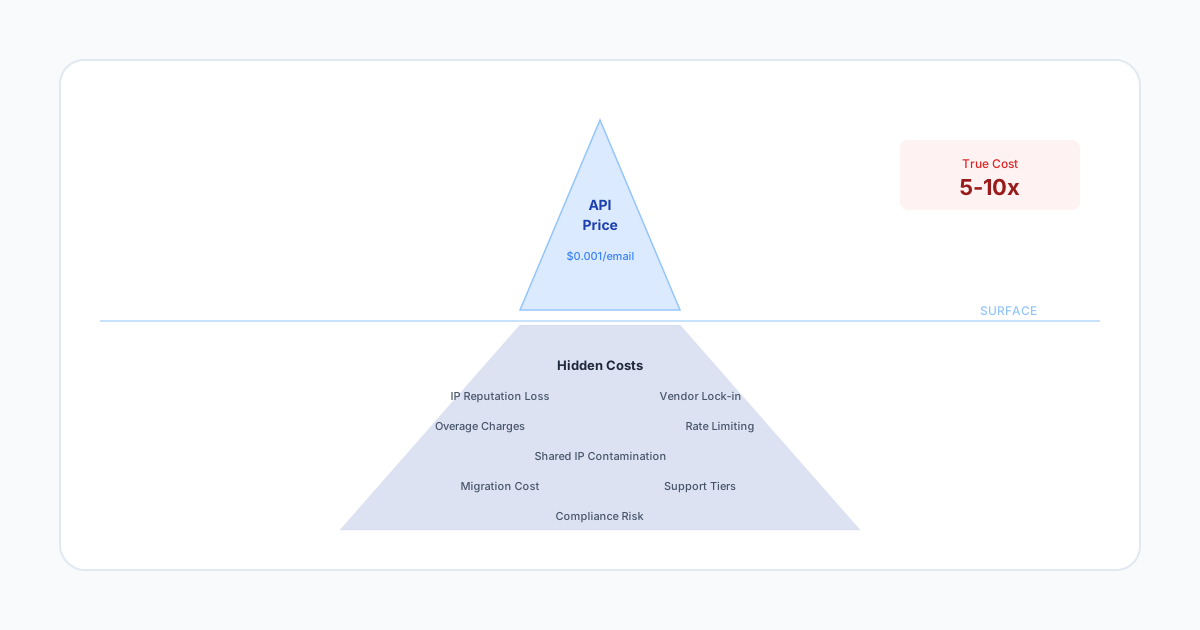
That $0.0001 per email looks attractive until you're sending millions of messages. Let's break down the real cost of email APIs and uncover the hidden fees that can double or triple your expected spend.
The Pricing Illusion
Most email API providers advertise simple per-email pricing that seems straightforward. But as your volume grows, the pricing model reveals its complexity - and its costs.
A typical pricing page shows something like: "$0.80 per 1,000 emails." Sounds simple, right? But that number rarely tells the full story. The base per-email rate is just the starting point. On top of it come dedicated IPs, validation services, analytics upgrades, support tiers, and overage charges that can quietly double your monthly bill.
We analyzed real pricing from four major email API providers to show exactly where the money goes. Every number below comes from publicly available pricing pages as of early 2026.
Provider-by-Provider Pricing Breakdown
Let's look at what four popular providers actually charge for a business sending 2 million emails per month.
SendGrid (Twilio)
SendGrid's Pro plan starts at $89.95/month for up to 100K emails. At 2M emails/month, you're looking at the Premier tier or custom pricing:
- Base sending (2M emails): ~$450/month on Pro with add-on contacts
- Dedicated IP: $89/month per IP (minimum 2 recommended for failover)
- Email validation: $0.004/email via separate Validation API - $8,000/month if validating full list
- Advanced analytics (Expert Insights): available only on Premier tier at custom pricing
- Priority support: $1,500+/month for dedicated account management
Mailgun (Sinch)
Mailgun prices by volume tiers with separate add-ons:
- Base sending (2M emails): ~$650/month on Scale plan
- Dedicated IPs: $59/month per IP
- Email validation: $1.20 per 100 validations on pay-as-you-go - $24,000/month for full list
- Log retention beyond 3 days: requires Scale plan ($650+ tier)
- Priority support: included in Scale, but dedicated support requires custom contract
Amazon SES
Amazon SES has the lowest base rate but the most DIY overhead:
- Base sending (2M emails): $0.10 per 1,000 = $200/month
- Dedicated IPs: $24.95/month per IP via dedicated IP pools
- Email validation: not included, requires third-party integration
- Analytics: basic metrics only, need CloudWatch ($50-200/month) plus custom dashboards
- Support: Business Support plan starts at $100/month minimum, scales with usage
- Engineering time: you build and maintain everything yourself - reputation monitoring, bounce handling, warmup logic, suppression lists
Postmark
Postmark focuses on transactional email with premium pricing:
- Base sending (2M emails): custom pricing above 1.5M/month tier
- Dedicated IPs: included at higher tiers
- Email validation: not offered, need third-party service
- No marketing email support - transactional only
- Message Streams separation is mandatory
Hidden Cost #1: Dedicated IPs
Serious senders need dedicated IPs for reputation control. On shared IPs, one bad neighbor can tank your inbox placement overnight. But dedicated IPs come at a premium:
- Additional monthly fees per IP (typically $20-90/month each depending on provider)
- You need at least 2-3 IPs for redundancy, failover, and warmup rotation
- Some providers charge extra for IP warmup services or automated warmup tools
- IP pool management features may require higher-tier plans
Real cost impact: Add $100-300/month for a proper dedicated IP setup. With SendGrid, three dedicated IPs alone cost $267/month.
Hidden Cost #2: Email Validation
To maintain list hygiene and protect your sender reputation, you need email validation. Many providers charge separately, and the costs add up fast:
- Verification API calls billed separately from sends
- Prices range from $0.003 to $0.012 per validation depending on provider
- You should validate your entire list before major campaigns and new subscribers in real-time
- Third-party validation services (ZeroBounce, NeverBounce) add another vendor relationship to manage
Real cost impact: For a 500K subscriber list validated monthly, add $1,500-6,000/month. Mailgun's validation pricing is particularly aggressive - validating 2M addresses would cost over $24,000.
Hidden Cost #3: Analytics and Webhooks
Basic plans often include minimal analytics. To actually understand your deliverability, you need advanced features that cost extra:
- Real-time webhooks may have volume limits or premium tiers
- Advanced analytics dashboards often require plan upgrades
- Log retention beyond 3-30 days frequently costs more (Mailgun retains only 3 days on lower tiers)
- Deliverability insights and ISP-level reporting are premium features
- With Amazon SES, you need to build your own analytics pipeline using CloudWatch, S3, and possibly Athena
Real cost impact: Add $200-500/month for full analytics, or $500-2,000/month if you factor in engineering time to build custom dashboards on top of SES.
Hidden Cost #4: Support and SLAs
When deliverability issues arise - and they will - you need expert support fast. A sudden reputation drop on a Friday afternoon can cost thousands in lost revenue. But premium support isn't free:
- Basic plans may only include community support or email tickets with 24-48 hour response times
- Phone or chat support often requires enterprise tiers
- Dedicated account managers cost $500-2,000/month extra
- SLA guarantees (99.9% uptime, guaranteed response times) require premium contracts
- Deliverability consulting is almost always a separate paid service
Real cost impact: Add $500-2,000/month for proper support access. SendGrid's dedicated support starts around $1,500/month.
Hidden Cost #5: Overage Pricing
Exceed your plan limits and watch costs skyrocket:
- Overage rates are typically 1.5-5x the base per-email rate
- Some providers charge for failed deliveries and bounces too
- Burst traffic during promotional campaigns can trigger unexpected overages
- Monthly plan resets mean a big campaign at month-end could push you into overage territory
Real cost impact: Can double your monthly bill during peak periods. One client we onboarded was paying $3,200/month in overage charges on top of their $1,800 base plan with a previous provider.
Hidden Cost #6: Engineering and Maintenance Time
This is the cost most teams forget to account for. With API-based email services, especially Amazon SES, your engineering team spends significant time on:
- Building and maintaining bounce/complaint handling logic
- Implementing suppression list management
- Creating IP warmup schedules and monitoring scripts
- Setting up and maintaining webhook processors
- Building dashboards and alerting systems
- Debugging deliverability issues without dedicated support
Real cost impact: At $150/hour for senior engineering time, even 10 hours/month of email infrastructure maintenance costs $1,500. Most teams we talk to spend 20-40 hours per month, putting the true cost at $3,000-6,000/month in engineering time alone.
The True Cost Comparison
Let's compare actual total costs for a business sending 2 million emails/month across all providers:
| Cost Category | SendGrid | Mailgun | Amazon SES | SMTPCloud |
|---|---|---|---|---|
| Base sending | $450 | $650 | $200 | Included |
| Dedicated IPs (3) | $267 | $177 | $75 | Included |
| Email validation | $600 | $1,200 | $500* | Included |
| Analytics | $300 | Included** | $200 | Included |
| Priority support | $1,500 | $500 | $100 | Included |
| Engineering time | $750 | $750 | $4,500 | $0 |
| Monthly total | $3,867 | $3,277 | $5,575 | $1,250*** |
* Third-party validation service. ** Basic analytics on Scale plan. *** SMTPCloud Growth plan with all features included.
The cheapest-looking option (Amazon SES at $200/month base) actually becomes the most expensive when you factor in everything needed to run a production email operation.
A Real-World Scenario
A fintech startup we worked with was sending 1.5M transactional emails per month through SendGrid. Their monthly breakdown looked like this:
- SendGrid Pro plan: $400/month
- Two dedicated IPs: $178/month
- ZeroBounce validation: $350/month
- Upgraded support after a deliverability crisis: $1,500/month
- Part-time DevOps engineer for email infra: ~$2,000/month
- Total: $4,428/month
After switching to SMTPCloud's managed infrastructure, their total cost dropped to $1,250/month - with better inbox placement rates and zero engineering overhead. The migration paid for itself in the first month.
The SMTPCloud Approach
We built our pricing to be transparent and all-inclusive. Every plan includes:
- Dedicated IPs with automated warmup - no per-IP fees
- Built-in email validation on every send
- Full analytics, real-time webhooks, and unlimited log retention
- Direct support from deliverability experts - no ticket queues
- No overage surprises - predictable monthly costs with flexible scaling
- Managed infrastructure - zero engineering maintenance required
When you compare total cost of ownership, not just per-email rates, the difference is significant. Our clients typically save 40-60% compared to their previous providers while getting better deliverability, faster support, and zero operational overhead.
Questions to Ask Your Provider
Before committing to any email service, get clear answers on these questions:
- What's included in the base price vs. add-ons?
- How are dedicated IPs priced and managed? Is warmup included?
- What are the overage rates, and are failed deliveries counted?
- What level of support is included? What's the guaranteed response time?
- How long are logs and analytics data retained?
- Are there any minimum commitments or annual contracts?
- What happens if I need to scale up quickly - is there a ramp-up period or fee?
- Do you charge for email validation, or is it built in?
Frequently Asked Questions
Is Amazon SES really cheaper for high-volume senders?
Only if you look at the base sending rate. SES charges just $0.10 per 1,000 emails, which is the lowest in the industry. But SES is a bare-bones API - you need to build everything else yourself. When you add the cost of engineering time for bounce handling, warmup management, analytics, and monitoring, SES typically becomes the most expensive option for teams without a dedicated email infrastructure engineer on staff.
Can I negotiate pricing with email API providers?
Yes, most providers offer custom pricing above 5M emails/month. However, the hidden costs (dedicated IPs, validation, support) are usually fixed add-ons that aren't part of volume negotiations. Always negotiate the total package, not just the per-email rate.
What volume level makes dedicated infrastructure worth it?
Generally, once you're sending more than 500K emails per month, a managed dedicated infrastructure like SMTPCloud starts saving money compared to API providers with add-ons. Below 100K/month, shared API services are usually more cost-effective.
How do I calculate my true email infrastructure cost?
Add up: base sending fees + dedicated IP fees + validation costs + analytics/monitoring costs + support tier costs + engineering hours spent on email infrastructure per month (valued at your team's hourly rate). Most teams are surprised to find the total is 2-3x their base sending cost.