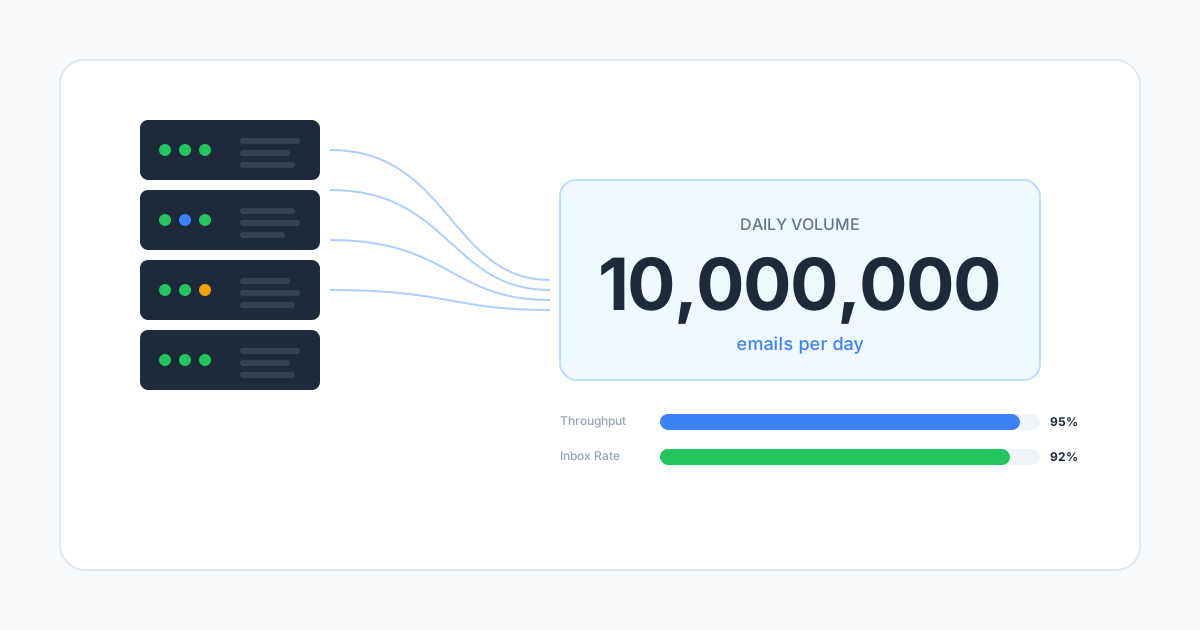
Scaling email infrastructure from thousands to millions of daily sends requires careful architectural decisions at every layer. Here's how we built SMTPCloud's infrastructure to handle 10 million emails per day while maintaining sub-second delivery times.
The Challenge
Email at scale isn't just about raw throughput. You need to balance multiple competing concerns: delivery speed, reputation management, bounce handling, feedback loop processing, and real-time analytics - all while maintaining 99.99% uptime.
Architecture Overview
Our infrastructure is built on three core principles:
- Horizontal scalability: Every component can scale independently
- Fault isolation: Problems in one area don't cascade to others
- Geographic distribution: Sending infrastructure close to major ISPs
The Ingestion Layer
All email enters our system through a distributed API layer that handles authentication, validation, and queuing:
- Load balancing: Traffic distributed across multiple availability zones
- Rate limiting: Per-customer and global limits prevent abuse and protect infrastructure
- Validation: Real-time checks for malformed requests, invalid addresses, and policy violations
- Queuing: Messages written to distributed message queues for reliable delivery
We use a combination of synchronous validation (immediate feedback on obvious issues) and asynchronous processing (detailed checks that would slow the API response).
The Delivery Engine
The heart of our system is the delivery engine - a fleet of sending servers optimized for SMTP delivery:
- Connection pooling: Persistent connections to major ISPs reduce handshake overhead
- Adaptive throttling: Automatic rate adjustment based on ISP responses
- Retry logic: Intelligent retry scheduling based on error types and ISP patterns
- IP management: Automatic failover and load distribution across IP pools
Reputation Management
At scale, reputation is everything. We built dedicated systems to protect and optimize sender reputation:
- Feedback loop processing: Real-time ingestion of ISP complaint reports
- Bounce classification: ML-powered categorization of bounce types
- Reputation scoring: Per-IP and per-domain health metrics
- Automatic remediation: Problematic traffic automatically rerouted or paused
Data Infrastructure
Processing 10 million events daily requires purpose-built data infrastructure:
- Event streaming: All delivery events flow through a central event bus
- Real-time analytics: Sub-second dashboard updates using stream processing
- Long-term storage: Compressed event archives for compliance and analysis
- Webhooks: Customer notification system handling millions of callbacks daily
Infrastructure Choices
Key technology decisions that enabled our scale:
- Bare metal servers: Dedicated hardware for predictable performance and IP control
- Custom MTA: Purpose-built mail transfer agent optimized for our workload
- Time-series databases: Specialized storage for metrics and analytics
- Edge caching: Reduce latency for API responses and webhook delivery
Monitoring and Observability
You can't manage what you can't measure. Our observability stack includes:
- Distributed tracing: Follow any email from API to delivery
- Real-time alerting: Anomaly detection for delivery rates, bounce rates, and latencies
- ISP dashboards: Per-provider delivery metrics and trend analysis
- Capacity planning: Predictive scaling based on historical patterns
Lessons Learned
Building this infrastructure taught us valuable lessons:
- Start with good abstractions - they make scaling easier
- Invest in observability early - debugging at scale is hard
- Build for failure - everything will fail eventually
- Maintain relationships with ISPs - technical excellence alone isn't enough
What's Next
We're continuously improving our infrastructure. Current focus areas include enhanced ML-powered deliverability optimization, expanded geographic coverage, and even faster analytics processing.