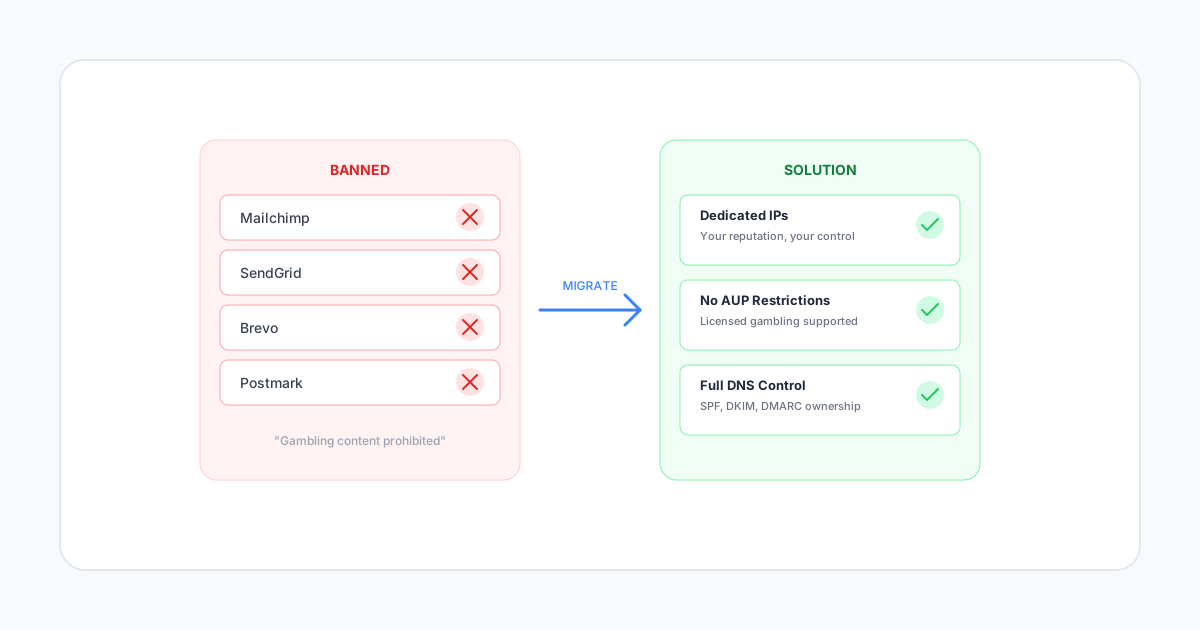
You set up your email campaigns, imported your player list, and hit send. A few hours later, your account is suspended. The reason: gambling content violates the acceptable use policy. This happens to iGaming operators every day, and it is not limited to Mailchimp.
Which ESPs Ban Gambling Content?
Nearly every major email service provider restricts or outright bans gambling-related email. Here is what their policies actually say:
Mailchimp (Intuit)
Mailchimp's Acceptable Use Policy explicitly lists "gambling services" as prohibited content. There is no exception process for licensed operators. Accounts sending gambling content are terminated, and remaining email credits are not refunded. Your data export window is typically 30 days, but during that period you cannot send any emails.
SendGrid (Twilio)
SendGrid's AUP restricts "gambling, sweepstakes, or lottery-related content" unless you obtain prior written approval. In practice, getting that approval is extremely difficult. Most iGaming operators report being denied or never receiving a response. Even those who receive temporary approval often find it revoked after a complaint spike.
Brevo (formerly Sendinblue)
Brevo prohibits "online gambling or casino" content. They perform content scans on outbound email, so even if your account is not flagged during signup, automated systems will catch gambling keywords in your campaigns and trigger a review.
Amazon SES
SES does not explicitly ban gambling in its AUP, but it enforces strict bounce and complaint thresholds. Gambling content generates higher complaint rates than most verticals. If your complaint rate exceeds 0.1% or your bounce rate exceeds 2%, SES will throttle and eventually suspend your sending. For iGaming operators, staying under these thresholds is a constant challenge.
Postmark
Postmark's AUP specifically prohibits "gambling or betting services." They review every account manually during onboarding, so gambling operators are typically rejected before sending a single email.
Why ESPs Enforce These Bans
ESP restrictions on gambling are not arbitrary. They are driven by concrete business concerns:
- Shared IP reputation: ESPs operate large shared IP pools. Gambling emails generate 2-5x higher complaint rates than typical commercial email. Those complaints damage the IP reputation for every sender on the pool
- ISP relationships: Gmail, Microsoft, and Yahoo maintain close relationships with major ESPs. If an ESP allows high-complaint gambling traffic, ISPs may throttle or block the ESP's entire IP range
- Legal risk: Online gambling legality varies by country, state, and even municipality. ESPs do not want the burden of determining whether a specific operator is legally permitted to email a specific recipient
- Payment processor requirements: The financial institutions that process ESP payments (credit card processors, banks) often have their own restrictions on gambling-associated businesses
- Content filtering triggers: Words like "casino," "free spins," "bonus," "bet," and "jackpot" are weighted negatively by ISP spam filters. High volumes of this content from an ESP's IP range can trigger broad filtering
What Happens When You Get Banned
An ESP account suspension creates immediate operational problems:
- Transactional email stops: Password resets, withdrawal confirmations, and KYC verification emails stop sending. Players cannot access their accounts or their money
- Data is at risk: Some ESPs give you 30 days to export your data. Others provide no grace period. Your campaign history, engagement data, and suppression lists may be lost
- No reputation portability: The IP reputation you built on the ESP's infrastructure stays with them. You start from zero with any new provider
- Revenue impact: For a mid-size online casino, email drives 15-25% of deposit activity. Every day without email costs real money. A 500K-player operator losing email for one week can see a EUR 50,000-150,000 drop in deposits
Your Options After a Ban
Option 1: Try Another Mainstream ESP
This is tempting but usually fails. If Mailchimp banned you, SendGrid will too. You might get a few weeks or months before detection, but the outcome is the same. Each ban also creates a record that makes future approvals harder.
Option 2: Build Your Own Infrastructure
Running your own MTA (Postfix, PowerMTA, Halon) on dedicated servers gives you full control. No one can ban you for your content. The trade-off is operational complexity: you need deliverability expertise, monitoring tooling, IP management, and ongoing maintenance. Realistic cost for a proper setup: EUR 4,000-8,000/month when you factor in infrastructure, tooling, and at least a part-time specialist.
Option 3: Use an iGaming-Friendly Email Provider
A small number of email infrastructure providers explicitly support gambling traffic. These providers offer dedicated IPs (your reputation is isolated from other senders), have experience with the deliverability challenges specific to gambling content, and understand regulatory requirements like MGA, UKGC, and GDPR obligations for gaming operators.
How to Migrate Without Losing Your List
If you have been banned or expect to be banned soon, act quickly:
- Export everything now: Download your subscriber lists, suppression lists (bounces, unsubscribes, complaints), campaign history, and engagement data. Do this before your account is fully locked
- Preserve your suppression lists: This is critical. If you move to a new provider and email previously bounced or complained addresses, you will damage your reputation on day one. Your suppression list is the most valuable data you have
- Plan for IP warmup: Any new sending infrastructure requires warmup. Budget 4-8 weeks to reach full volume. During this period, prioritize transactional emails and send marketing only to your most engaged segments
- Update your DNS records: SPF, DKIM, and DMARC records need to point to your new infrastructure. Plan DNS changes carefully to avoid authentication failures during the transition
- Run parallel systems: If possible, keep your old system running for transactional email while warming the new one. This minimizes disruption to player-facing communications
Preventing the Next Ban
The only way to guarantee you will not be banned again is to use infrastructure designed for iGaming traffic. SMTPCloud provides dedicated email infrastructure for iGaming operators with no AUP restrictions on licensed gambling content. Dedicated IPs, proper warmup, deliverability monitoring, and regulatory compliance support are included.
Stop treating ESP bans as a surprise. They are an expected outcome of sending gambling content through platforms that prohibit it. Choose infrastructure that matches your business.